

Three Pimples: A Victory Written in Blood, Courage and Honour – 29 June 1999
Some dates never fade from memory.
For most people, 29 June 1999 is another chapter in the history of the Kargil War. For me, it is a night frozen in time: a night of extraordinary courage, unimaginable sacrifice, and a victory that came at an unbearable cost. These are not just Indian Army stories preserved in history; they are real-life inspirational stories that remind us of the price of our freedom and the extraordinary men who chose the nation above themselves.
Every year, as this day returns, it fills my heart with two emotions that can never be separated: immense pride and profound pain. Pride, because our soldiers achieved what many believed was impossible. Pain, because the road to that victory was paved with the lives of some of India’s finest young officers and soldiers.
The battle for the Three Pimples area remains one of the fiercest and most difficult operations of the Kargil War. The enemy occupied commanding heights, protected by fortified bunkers and overlooking every possible approach. Every step upwards meant walking into enemy fire. Every metre gained demanded courage beyond imagination.
Even the senior military leadership knew how difficult the assault would be. Yet, for the soldiers of the Indian Army, failure was never an option. The honour of the nation rested on those icy heights.
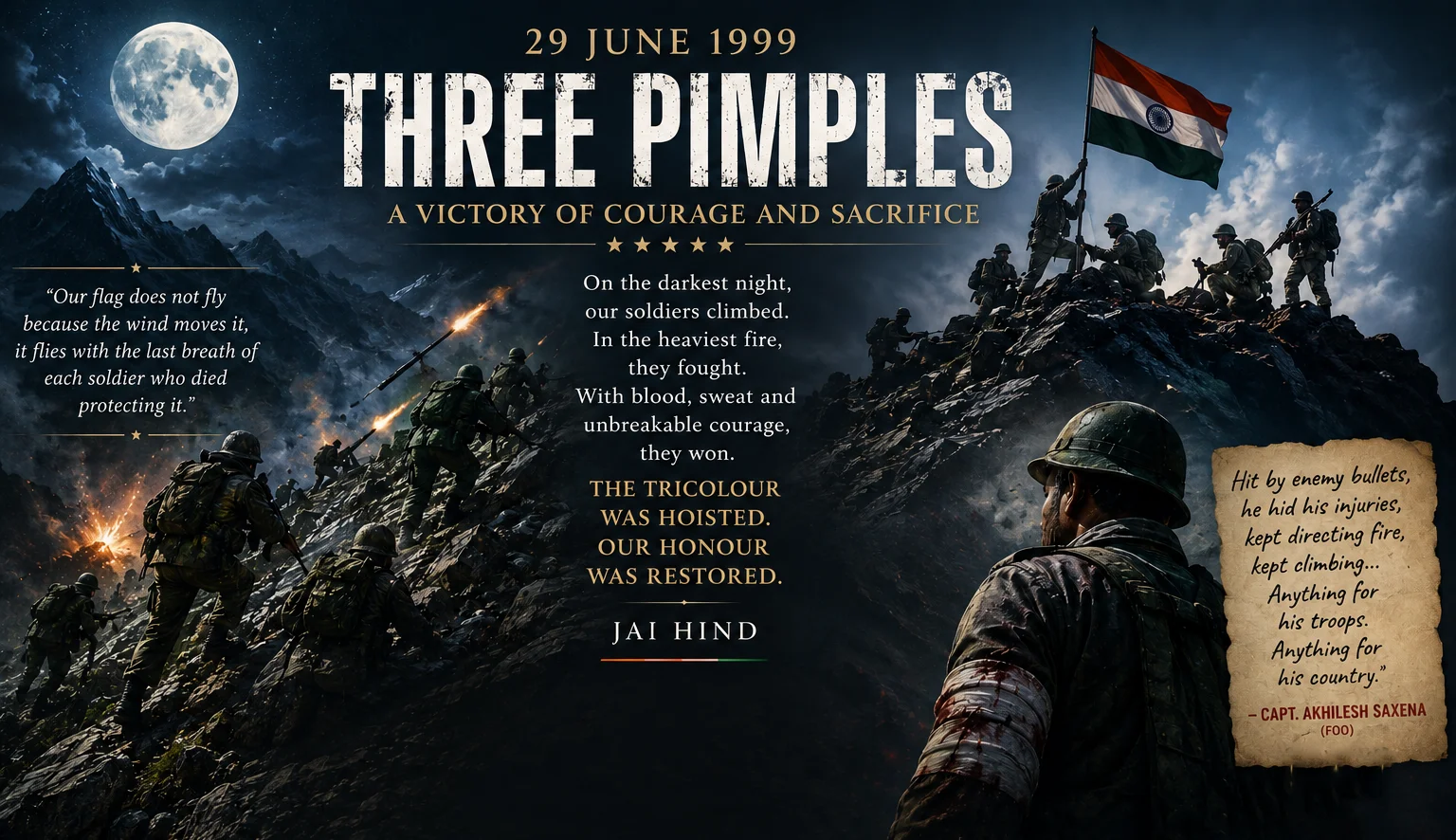
On the night of 28 – 29 June 1999, under the light of a full moon, silence covered the mountains. Ironically, the bright moonlight made the assault even more dangerous. There was nowhere to hide. Every movement could be seen by the enemy waiting above.
At around 2 a.m., the brave men of 2 Rajputana Rifles began climbing towards the Three Pimples feature. Once again, they were supported by Captain Akhilesh Saxena, serving as the Forward Observation Officer from the Regiment of Artillery. It was the same team that had fought together to secure the historic victory at Tololing just days earlier.
As the infantry climbed nearly vertical cliffs, Captain Akhilesh continuously directed artillery fire onto enemy positions. The precision of the Indian Artillery created brief windows through which the assaulting troops could move closer to the objective. Every correction he passed over the radio helped save lives and pushed the attack forward.
But the enemy was relentless. Machine guns, mortars, rockets, and artillery rained down on the advancing soldiers. For nearly eight exhausting hours, the battle continued in freezing temperatures over unforgiving rocks. Every bunker had to be captured through close combat.
The victory demanded an enormous price
Major Padmapani Acharya displayed exceptional leadership until he made the supreme sacrifice. Captain Vijayant Thapar, only twenty-two years old, fought with extraordinary courage before laying down his life for the nation. Captain Neikezhakuo Kenguruse, despite severe difficulties, pressed forward with fearless determination and became another immortal hero of that night.
Their stories continue to inspire generations of Indians, reminding us that age is never a measure of courage. These are the stories of courage that define India’s Armed Forces. They teach us that true bravery is not the absence of fear but the willingness to move forward despite it. They remind every generation that freedom survives because ordinary young men perform extraordinary acts of courage when the nation calls.
Amid this fierce battle, Captain Akhilesh Saxena was struck by enemy bullets and seriously wounded. Bleeding heavily, he chose silence over concern. He did not reveal the extent of his injuries because he knew that if his troops stopped to help him, the momentum of the assault could be lost.
- He continued climbing.
- He continued directing artillery fire.
- He continued doing his duty.
Only after the objective had been secured and the Tricolour proudly flew over the Three Pimples feature did the extent of his injuries become impossible to ignore.
Even then, the battle was not over for him. With severe bullet injuries and tremendous blood loss, he walked down the mountain for nearly five hours before receiving his first medical aid. Survival itself became another battle.
Just two months earlier, we had been married. While I waited hundreds of kilometres away, unaware of what was unfolding in those mountains, he was fighting for the nation alongside brothers-in-arms who would never return home.
That night was not only about military strategy or capturing a peak. It became one of the greatest stories of sacrifice in the history of the Kargil War, a reminder that victory is often written with courage, endurance, and the willingness to put the lives of others before one’s own.
Today, he lives with permanent injuries and memories that no passage of time can erase. Like thousands of Kargil veterans, he also carries the invisible wounds—the faces of friends who laughed together, fought together, and made the ultimate sacrifice together.
Whenever we celebrate victory, we must also remember its cost. Behind every captured peak lies a family whose son never returned home. Behind every medal lies a story of sacrifice. Behind every fluttering Tricolour stands a generation of soldiers who chose duty over life itself.
The victory at Three Pimples was not simply a military success. It was a testament to the indomitable spirit of the Indian soldier; men who climbed impossible mountains under enemy fire, knowing that many of them would never return.
As we remember this day, let us not merely celebrate a victory. Let us honour the courage, selflessness, and sacrifices that made it possible.
Freedom is not inherited. It is earned, protected, and renewed by brave hearts willing to give everything for a nation they love. If these stories continue to live in our hearts, then the sacrifices of our soldiers will never be forgotten.
Jai Hind.
— Shikha Akhilesh Saxena
To understand the human side of the Kargil War—the courage on the battlefield and the resilience of the families waiting at home—read Nation First, a true story told through firsthand experiences.